


The Massage Industry Has a Regulation Problem
Jump to topic:
No National Standard | Massage Regulations – Unincorporated San Diego County | Why Licensing and Certification Matter | Red Flags in a Practice | How We Approach This | Massage is Healthcare, Not Just a Bonus | Verify Certification
First, a Note on Why This is Being Addressed
We’re writing about massage regulation because it isn’t just an industry problem, it’s something we deal with week after week. As professional massage therapists and/or business owners, we’re constantly having to prove we’re legitimate while simultaneously trying to avoid situations that put us in danger. We screen calls carefully, are by appointment only, and constantly brace ourselves for the occasional client who walks in expecting something that we most definitely don’t offer. As a therapist, and business owner, this really breaks my heart. The fact that we feel the need to address this in a blog post because it continues to be unregulated nationally is just flat out ridiculous.
We’ve spent years training to do this work safely and professionally because we are truly passionate about healing and wellness. It’s frustrating to have that overshadowed by businesses that were never about massage at all.
Better regulation wouldn’t just protect clients, it would protect massage therapists too.
When you book a massage at a local massage therapy business, you would assume that the therapists have gone through the required schooling and have the appropriate certifications. What you probably don’t know is that massage therapy sits in a gray area when it comes to certifications. It is simultaneously treated as a legitimate healthcare practice (used for pain management, post-surgical recovery and stress-related illness) and a luxury service.
That gray area is present due to the massage industry’s regulation problem. And if your wellness routine includes massage therapy for either wellness or luxury, it can negatively affect you.
No National Standard for Massage Therapists
There is no one federal license for massage therapists in the United States. Regulation happens state by state, and the differences vary:
Required Training Hours
To get your license, the required hours range from 330 to over 1,000 depending on the state.
No Licensing Requirement
A handful of states lack a statewide licensing requirement, leaving oversight to counties, cities, and in some cases no one at all.
Massage Regulation in Unicorporated San Diego County
California has no state massage license requirement. The California Massage Therapy Council issues voluntary certifications to massage professionals that meet the requirements in state law, and CAMTC certification is not required by state law for a massage professional to practice in California.
Since Lakeside, CA is unicorporated, it is governed directly by the County of San Diego. Several years ago, we wanted clarification about exactly what licensing was required for a massage establishment in Lakeside, CA. So we went directly to the source.
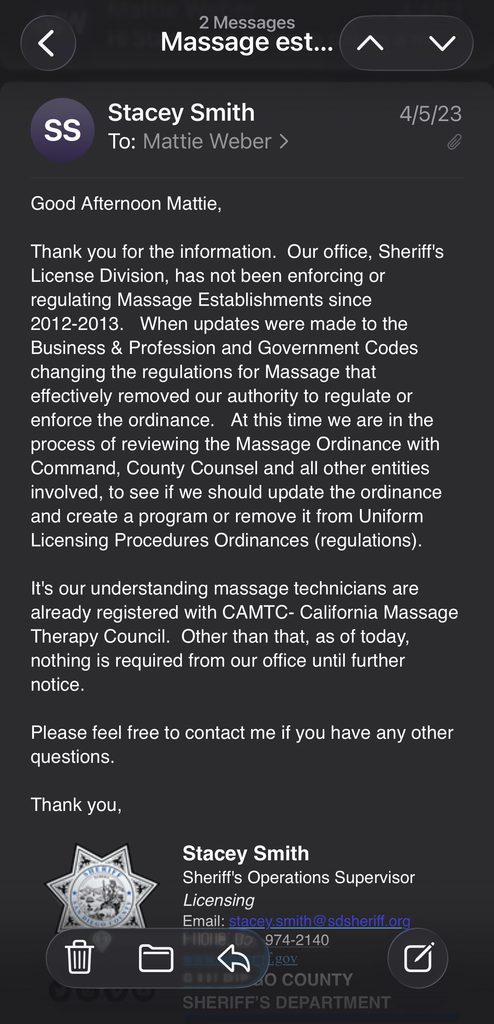
In October 2023, Weber Massage Therapy & Wellness contacted the San Diego County Sheriff’s Department Licensing Division. We were informed that the Sheriff’s Department was no longer issuing massage establishment licenses and were directed to CAMTC regarding massage certification.
Since then, San Diego County’s rules have become even clearer.
In June 2026, the San Diego County Board of Supervisors adopted Ordinance No. 11002, removing obsolete licensing provisions. County records explain that the Sheriff’s Licensing Division no longer issues local permits for massage establishments, massage technicians, or bathhouses.
San Diego County’s Department of Environmental Health and Quality also states that it no longer regulates massage facilities in unincorporated areas of San Diego County, effective October 1, 2021.
This does not mean massage businesses are exempt from laws or oversight. Zoning, building and safety requirements, employment laws, criminal laws, and other regulations still apply.
However, it does mean consumers should not assume that simply because a business advertises “massage,” the individual providing that massage has completed professional massage education or holds CAMTC certification.
That’s why knowing how to check someone’s credentials is important.
No Common Legitimate Procedures
Continuing education requirements, background check rules, and enforcement mechanisms vary widely.
This general lack of standardization opens the door for misuse. Because “massage” isn’t a protected term everywhere, anyone can use the word for any business, even those whose services don’t pertain to actual massage therapy. Unfortunately, this includes fronts for human trafficking and other types of illicit activity, a problem law enforcement agencies and anti-trafficking organizations have struggled with for years.
Thankfully, most massage businesses are legitimate, but the lack of consistent oversight and standard regulations makes it harder for people to tell the difference.
Why Licensing and Certification Matter
A license isn’t just a piece of paper. In states with meaningful requirements, it typically means the therapist has:
- Completed several hundred hours of supervised training in anatomy, physiology, pathology, and technique
- Passed a standardized competency exam (commonly the MBLEx)
- Met continuing education requirements to keep the license active
- Been through a background check
What is CAMTC Certification?
The California Massage Therapy Council (CAMTC) is the organization that certifies qualifying massage professionals in the state of California. Therapists are thoroughly trained and practice extensively to learn how to give safe and effective massages.
But there’s one important distinction: CAMTC certification is voluntary under California state law.
California does not automatically require every person providing massage to become CAMTC certified. Local governments can impose their own requirements within the limits of state law.
However, someone seeking CAMTC certification must meet established requirements, including:
- Being at least 18 years old
- Completing at least 500 hours of qualifying massage education from a CAMTC-approved school
- Completing required education in subjects such as anatomy and physiology, contraindications, health and hygiene, and business and ethics
- Having official educational transcripts submitted to CAMTC
- Completing Live Scan fingerprinting
- Undergoing a criminal-background review
- Providing required identification and documentation
- Meeting CAMTC’s professional-conduct standards
CAMTC can also investigate applicants and certificate holders regarding certain criminal, disciplinary, and professional-conduct matters.
Certification doesn’t mean every CAMTC therapist will be the right therapist for every client. Massage styles, specialties, additional training, and experience vary. What certification does provide is a professional credential that consumers can independently verify.
A certified massage therapist that has been properly educated on the human anatomy and massage techniques will:
- Screen for contraindications (blood clots, certain cancers, pregnancy complications, recent surgeries)
- Understand how much pressure is safe on which tissues
- Know when a client needs a referral to a physician instead of a massage
Untrained or unlicensed practitioners most likely don’t know any of that, and the client has to find out the hard way when something goes wrong.
Red Flags in a Practice
If you’re booking a massage at a spa or an independent practitioner, there are a few red flags you should be looking out for:
Sexualized Pictures of “Massage Therapists”
Massage therapy shouldn’t be marketed as a sexual experience. Professional massage advertising should focus on:
- Education
- Experience
- Modalities
- Specialties
- Client Care
Be cautious when a massage website features provocative photographs of therapists, revealing clothing, suggestive poses, or images designed primarily around the physical attractiveness or sexuality of the person providing the massage.
Discreet or Back-Door Entrances
A rear entrance isn’t inherently suspicious. Businesses may have rear entrances because of parking, accessibility, building design, employee access, or other legitimate reasons.
The distinction is how it’s being advertised. If a massage business specifically promotes a discreet entrance, private entrance, or back-door access so customers won’t be seen entering, it’s reasonable to ask why discretion is being marketed as part of the experience.
Combined with other warning signs, that’s a reason to investigate further.
Suggestive Language
Pay attention to how services are described. Phrases such as:
“We’ll treat you like a king.”
“Special treatment”
“Beautiful girls”
“New girls”
“Young therapists”
Or language hinting at “extras” should encourage you to look more closely, particularly when combined with sexualized photographs or vague descriptions of the actual massage services.
One phrase by itself doesn’t prove wrongdoing, context matters.
Read Online Reviews
Reviews can sometimes tell you more than the business’s own website.
Professional massage reviews commonly discuss:
- Pressure and technique
- Pain relief
- Relaxation
- Sports recovery
- Communication
- Cleanliness
- Professionalism
- How the client felt afterward
Take a closer look when reviews repeatedly focus instead on how attractive the therapists are, receiving unspecified “special treatment,” or language that appears to hint at something beyond professional massage therapy.
Again, one strange review isn’t proof of anything. A pattern is more concerning than an isolated comment.
No Visible CAMTC Certificate
Certified massage therapists are generally required to display their certificate. If you ask to see your therapist’s license and your question is ignored, they refuse, or try to convince you otherwise, it’s a red flag.
At Weber Massage Therapy & Wellness, our massage therapists’ CAMTC certificates are displayed together on the wall before you enter our massage rooms. This is done intentionally. We want clients to be able to see the professional credentials of the therapists working in our office.
When visiting another massage establishment, take a look around.
Are CAMTC certificates displayed?
Does your therapist’s name match the certificate?
Can you independently verify that person’s CAMTC certification? (You can verify certification here by clicking the ‘Verify Certification‘ option.)
A professional therapist should be comfortable with reasonable questions about their credentials.
No Intake Process
Skipping the basic health screening used to assess a client’s health conditions is very dangerous, and not just done to make things easier. Before your session, a legitimate therapist will ask about your:
- Injuries or areas of pain
- Recent or previous surgeries
- Pregnancy
- Medical conditions
- Medications
- Areas you’d like addressed
- Areas you don’t want massaged
- Your goals for the session
Cash-Only, No Appointments, or No Online Listing
Legitimate practices all have some sort of:
- Paper trail
- Booking software
- Reviews
- Business listing
Pressure of Offered Services
Any pressure toward services outside standard therapeutic massage is a serious red flag. You can ask for more or less pressure, tell your therapist not to work on a particular area, ask questions, or end the session.
A professional massage therapist respects those boundaries.
Unprofessional Appearance
A massage therapist should be clean and appropriately dressed for a professional wellness environment.
Unusually Low Prices or Vague Services
Questionably low pricing can hint that a business isn’t paying therapists legally or isn’t following labor and licensing laws.
Be cautious of intentionally vague services, you should know what you’re paying for. A professional business should clearly communicate the service, appointment length and cost.
High Staff Turnover or Frequent Rebranding
Businesses that change names often or repeatedly “reopen under new management” may be trying to avoid local scrutiny. Also, a constant rotation of new employees can be a sign that staff are being moved between locations, a common pattern in trafficking operations.
Professional Draping and Privacy
You should be given complete privacy to undress and dress.
During a professional massage, appropriate draping should be maintained. Your therapist should explain anything unfamiliar and respect your comfort level and boundaries.
A Clean Establishment
Treatment rooms, massage tables, common areas, and linens should be clean and appropriately maintained.
How We Approach This
At Weber Massage Therapy & Wellness, this lack of regulation is a big reason why we are careful about who we hire and how we operate.
CAMTC Certification Required
Every therapist we employ holds a valid California massage therapy certificate. We verify that before anyone touches a client, not just when hiring, but on a consistent basis.
Health Screenings Required
All therapists must complete a health screening and consent process with every client before every session.
Background Checks
Background checks are processed via CAMTC and are required for certification.
Continued Learning Encouraged
At Weber Massage Therapy & Wellness, our therapists are encouraged to participate in continuing education, covering both technique and ethics.
Insurance Required
We carry professional liability insurance and ensure that our rooms stay safe and sanitary.
We think this level of transparency should be the bare minimum for every massage and wellness practice. Due to the lack of regulation, we like to be completely transparent with our clients.
Massage is Healthcare, Not Just a Bonus
Therapeutic massage belongs in the same conversation as other forms of preventive healthcare, not just categorized as a luxury. Chronic stress, pain, and the physical toll of overworking are real health issues, and massage therapy is a legitimate, proven way to help those issues.
If you’re booking a massage, please don’t be shy about asking to see certification, asking about training, or asking how a business vets its therapists. A reputable practice will welcome the question.
Resources
CAMTC: Verify Massage Certification Online
CAMTC: Requirements to Certify